
he/him || feel free to ask for suggestions
312 posts
People's Songs Newsletter 1947-8

people's songs newsletter 1947-8
A singing union is a winning union
-
 greengrowsthelaurel liked this · 1 year ago
 -
 chronically-chaotic-cryptid liked this · 1 year ago
 -
 mtfsillybilly liked this · 1 year ago
 -
 folk-enjoyer liked this · 1 year ago
 -
 itscecils liked this · 1 year ago
 -
 ohg0d liked this · 1 year ago
 -
 ruzqtx liked this · 1 year ago
 -
 barnettshale liked this · 1 year ago
 -
 percyjacksonwriter reblogged this · 1 year ago
 -
percyjacksonwriter liked this · 1 year ago
-
 paulkleefishmagic reblogged this · 1 year ago
More Posts from Folk-enjoyer
i found a pdf of most of the "People's Songs" publications from june 1948 (vol. 3 no.5) that featured the song Frozen logger

this confirms that Ivar Haglund *did* perform it on his radio show and that he was the one who taught it to earl Robinson
Suggested song
"The Frozen Logger" The Weavers, 1951
"The Frozen Logger" was originally written and performed in 1929 by Jim Stevens (the man who popularized the folk legend Paul bunyan in his 1925 book "Paul Bunyan"
for his program on the ABC seattle network "The Histories of Paul Bunyan"
here's a segment of Jim Stevens talking about that himself:

Oregon Historical Quarterly Vol. 50, No. 4 (Dec., 1949) pp.235-242
it's possible that the song was performed by Ivar Haglund (notable for his prolific seafood themed songs and clam restaurant) in the early to mid 1940s on his radio show "Around the Sound" where he would sing folk music for 15 minutes, and I found a couple sources listing him as either the copyright owner of the song, or the writer (he did not write the song). He was friends with Jim Stevens, and it's likely that Stevens taught him the song.
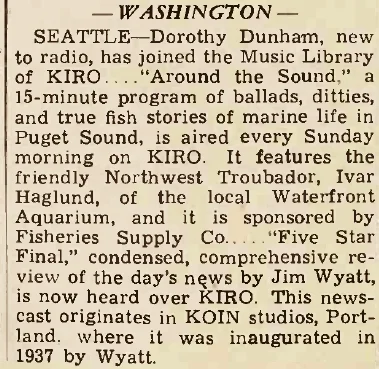

Radio Daily, July 1944 and KJR flyer, 1942
Many secondhand sources mentioned that "The Frozen Logger" was based on an old tune or an old ballad, with words that were originally written by Jim Stevens, including Jim Stevens himself though he's not specific. I think i might be the first person ever to point out that the ballad it was based on belongs to the folk song family of "The Unfortunate Rake"/ "The Unfortunate Lad" (recorded here in the 1960s and performed by A.L. Lloyd) it has a similar story structure, similar characters, similar rhymes, and similar composition.
in " 'The Unfortunate Rake' and His Descendants" by Kenneth Lodewick, the original song is dated as being from ireland in 1790, and one of its earliest printings was in England in 1850 as a folk ballad

as you might be able to guess if you're familiar with cowboy ballads, this song is also the origin of "Streets of Laredo" or "The cowboys lament" which emerged in the late 1800s from cowhand workers. A cowhand in the late 1870s named Frank H. Maynard has claimed to write the song in 1876 and published his version in "Cowboy's Lament: A Life on the Open Range" in 1911 after it was published in Alan Lomax's "Cowboy Songs and Other Frontier Ballads" in 1910. in my opinion, i think this song could have multiple origins.
the oldest recording i could find was by Harry McClintock in 1928
as an aside, there was also ANOTHER lumberjack version of the song collected by John C. French called "The Wild Lumberjack" from Pennsylvania logging camps dated between 1870-1904/1905. performed here by Kenneth S Goldstein (1960s). This song isn't the origin of "The Frozen Logger" but it's interesting that there are two songs like this.
I believe that "The Frozen Logger" is an adaptation from the cowboy version. Jim Stevens grew up in Idaho and worked in Montana (where he mentions learning many songs) and in 1959, he gave an interview with Ivar Harglund about how he used traditional folk and country music and created new and topical lyrics for the Keep Washington Green Campaign in the 1940s
The first ever publishment and recording (That I could find) of "The Frozen Logger" was in 1947 by Earl Robinson in his Keynote Album, commented upon by the Chicago star by Raeburn Flerlage that same year.

The Chicago Star (Chicago, III.) April 5, 1947 (p.13). Library of Congress
Pete seeger, one of the Weavers, was (for some reason that escapes me) friends with Ivar Haglund (who was friends with Jim Stevens) and, like with the song "the Old Settler" , it is likely that Haglund taught the song to Pete Seeger who then, with the rest of the Weavers, performed it in 1951, popularizing the song.
for @slowtraincumming
Song of the day
(do you want the history of your favorite folk song? dm me or submit an ask, and I'll do a full rundown like here)
"Don't Think Twice, It's Alright" Bob Dylan, 1963
"Don't Think Twice, It's Alright " was first written in 1962 and was first released in 1963. It's based on Paul Clayton's song, "Who's gonna buy you Ribbons ?(When I'm Gone)" released 1960
in Dylan: A Biography by Bob Spitz, he writes,
"Some time before the song appeared, he [bob dylan] ran into Clayton, Van Ronk, and Barry Kornfeld, another Village folksinger, at which time he said, 'Hey, man—I really dig ‘Who’s Gonna Buy Your Ribbon Saw.’ I’m gonna use that.' No one gave it a second thought. Clayton himself had copied it from an old music-hall number called 'Who’s Gonna Buy Your Chickens When I’m Gone.' The guys figured, 'Fair enough—Bob’ll probably do a nifty variation on the theme.' Unfortunately, 'Don’t Think Twice' is a dead ringer for 'Ribbon Saw'" (p.200)
and the lyrics, despite both songs being short, are very similar.


Stephen Wilson, Paul Claytons Roomate says
"[Paul Clayton] had taken two different ideas. I know this from Clayton’s own lips. He slightly changed the tune to ‘Call Me Old Black Dog.’ The words were a song he’d picked up a sheet copy of in the University of Virginia library, called ‘Who’s Gonna Buy You Chickens When I’m Gone.’ He liked the idea of it" Paul Clayton and the Folksong Revival by Bob Coltman, 2008 p. 132
Despite multiple accounts in Spitz's biography of Bob Dylan of "Who's Gonna Buy Your Chickens When I'm Gone" being a popular traditional folk song that Cynthia Gooding claimed to perform twice, there exists no recorcing or publishing of its lyrics in this Time period. The closest thing i could find was the song "Whos Goñ Bring You Chickens?" from "Eight Negro Songs (From Bedford co. Virginia)" collected and published by Francis H. Abbott in 1923


since there were no recordings available for this song, i also digitally reproduced the sheet music and recorded the song using sheetmusic reader software
here's just the vocal melody
the other song mentioned, "Call me Old black dog," is a traditional folk song with many different variations, including possibly "Salty dog." from what i could tell it was first recorded in 1929 by Dick Justice
and in 1930, by Bayless Rose
these two versions of "Black Dog Blues," the chicken version of the song, and Paul Clayton's version all remind me very very heavily of the song, "Goin' Down the Road Feeling Bad"
specifically this one by elizabeth cotten (1958)
and this one by Woody guthrie (1938-1940)
"Goin' Down that road feeling bad" was first recorded in 1923 by Henry Whitter as "Lonesome Road blues"
i don't know where else to put this but i also think Phil Ochs' "When I'm Gone" (1966) could have been inspired by one of these songs (in my opinion Paul Clayton's, as it sounds similar to the others to me)
Based on the biography interviews, it seems that Bob Dylan was widely criticized by other folk singers not for covering and changing a traditional folk song (that's a commonplace practice in folk music) but for copyrighting both the lyrics and the melody to this song, rather than just crediting the melody as "traditional" or just mentioning paul clayton at all. While Paul Clayton was struggling to make money, "Don't Think twice, it's Alright," made a lot. Either way, "Don't Think Twice, Its Alright" is a staple of the genre and has defined folk for a generation.
Suggested Song
(do you want the history of your favorite folk song? dm me or submit an ask, and I'll do a full rundown like here)
"Plastic Jesus" Tia Blake, 1971
Plastic Jesus was originally written by George Cromarty and Ed Rush in 1957 and performed live in 1962 at the San Francisco State College Folk Festival, where it was recorded and released later that year in their duo band The GoldcoastSingers.
the back of their debut Album reads
"On a foggy Sunday afternoon in March of 1962, THE GOLDCOAST SINGERS clambered on stage at San Francisco State College before an unsuspecting audience of 1,000 or so. After they were introduced as the final performers at the San Francisco State Folk Festival, people in the audience mumbled, "Who?". This query was followed by shouts of "More!". The reaction was, to say the least, wild. After five encores, breathless and perspiring like pigs, they came on for one last "song," entitled "Plastic Jesus." This ode flattened the audience. All through the performance people had been walking out of the auditorium grumbling, "Mis-guided youth" and "Whippersnappers," but the finale was too much for those whose soft spots had not yet been touched. A dozen (actually twelve) marched up the aisles in righteous indignation. The remaining nine hundred some odd rose in a tremendous ovation. Fortunately that concert was taped, and this record is the product"
I think that the truth is stretched here a bit, and like with the song "Plastic Jesus," it is meant to be comedic.
This is the only album produced by The Goldcoast Singers, but George Cromarty would continue to produce music as a solo artist.
later, in 1964, the song was recorded and performed by Ernie Marrs and was mentioned in Vol. 14, no. 2 in "Sing Out! Magazine.
with Ernie Marrs being credited with writing the lyrics.

Later, in 1967, the song was featured in the movie "Cool Hand Luke", performed by Paul Newman. Interesting for taking the satirical and comedic song and reimagining it as somber. this movie is likely what popularized the song in addition to its feature in the magazine.
in 1971, Tia Blake released what is effectively her only album in France, which led to it being mostly forgotten until it was re-released in 2011. Since then, it has become more well-known. This makes me very happy because i love this album! i think all the songs on it are beautiful and wonderfully made. It's a shame she didn't record more.
I think something very interesting happened with the song, and these 4 covers effectively tell a story with how they each re-imagine it.
the original lyrics by The Goldcoast Singers are biting with satire and are funny if not a bit mean-spirited. We, as the audience, are not meant to relate with the person with the plastic Jesus bobblehead.
then, ernie marrs' version doesn't have the intro of the original duo, and shortens the lyrics a bit, but like other works that Ernie Marrs helped write like "The People are Scratching" and "What a Friend we have in Congress" (1966) and (1963)
the humor and satire are a bit more gentle and more subtle. To me, it feels like if you aren't really paying attention, you could miss it. it's comedic, but it could pretty easily be remembered as a charming fun folk song rather than a satire on Christian commercialism and a way of making fun of rednecks.
the movie version song is completely different. I'll be honest, i have not seen this movie, but it seems like this song is 1. completely genuine and devoid of sarcasm, and 2. very, very sad. the song morphs into bitter melonchy. it is the farthest thing from funny.
Tia Blake's version returns the song to its roots. kind of. Her version is certainly happy, but it's also painfully genuine. It is also the only song in her 1971 album that i would describe as happy, the rest being mournful, spooky, or full of longing. plastic Jesus is an odd choice. AND, her cover is my favorite. I think there is something beautiful and whimsical about the story presented in the song, about having so much joy come from a mundane object. Its a cheerful and hopeful song in an otherwise tragic album.
the first time i heard the song by tia blake was in a folk punk playlist. i didn't understand why it was on there at first, but i do now. there is a sort of revolutionary optimism in finding hope from the mundane in the midst of hopeless circumstances.
for @ruzqtx
Joan Baez & Bob Dylan "With God On Our Side" Newport Folk Festival, July 25, 1964.
