Theologicaldeterminism - Tumblr Posts
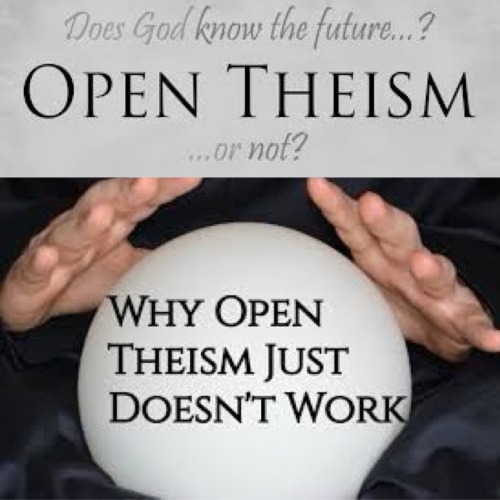
Is Open Theism Biblical?
By Bible researcher Eli Kittim
Open Theism
“Open theism” (aka openness theology) is a theological movement which holds that God doesn’t exercise complete sovereignty over the universe but allows it to be “open” to the contribution of human free will. Put differently, because God cannot possibly know the future in an exhaustive sense, the future is not predetermined by him. Paradoxically, even though open theists seem to affirm God’s omniscience, they nevertheless deny God’s foreknowledge and claim that he doesn’t know everything that will occur. In his book “The Grace of God, The Will of Man,” Clark Pinnock, a Christian theologian and proponent of open theism, writes:
Decisions not yet made do not exist
anywhere to be known even by God. They
are potential— yet to be realized but not yet
actual. God can predict a great deal of
what we will choose to do, but not all of it,
because some of it remains hidden in the
mystery of human freedom … God too faces
possibilities in the future, and not only
certainties. God too moves into a future not
wholly known …
Similarly, in his book “Letters from a Skeptic,” author Greg Boyd, a leading advocate of open theism, explains it thusly:
In the Christian view God knows all of reality
—everything there is to know. But to assume
He knows ahead of time how every person
is going to freely act assumes that each
person’s free activity is already there to
know—even before he freely does it! But it’s
not. If we have been given freedom, we
create the reality of our decisions by
making them. And until we make them, they
don’t exist. Thus, in my view at least, there
simply isn’t anything to know until we make
it there to know. So God can’t foreknow the
good or bad decisions of the people He
creates until He creates these people and
they, in turn, create their decisions.
Open theism is basically a new model through which scholars have tried to explain the relation of God’s foreknowledge to the free will of human beings. Their argument runs as follows: humankind could not really be free if God knew absolutely everything pertaining to the future. And since open theists believe that human beings are completely free, it follows that God cannot absolutely know all there is to know about the future. This argument would carry over to our understanding of Biblical eschatology and would suggest not only that the future is unknowable, but also that God doesn’t know the future.
Invalid Arguments
However, it seems to me that open theists are committing a logical fallacy, namely, equating the foreknowledge of God with determinism. If that were the case, their conclusion would be correct, to wit, that a deterministic foreknowledge of God would necessarily be incompatible with human free will. But the premise is misconceived. Foreknowledge in and of itself doesn’t necessarily presuppose determinism. Just because God can foresee the future doesn’t mean that he causes it. Calvinism, of course, is the other extreme which maintains that God is the cause of all events, thereby postulating hard determinism without apologies. However, If we, as free agents, were to act in whichever way we chose, and God could foresee our decision, God’s foreknowledge and human free will would be perfectly compatible!
What is more, Open Theism asserts that although God knows all truths, there are certain possibilities which cannot yet be established about the “open” and undetermined future, and thus even God himself doesn’t know their outcome. But this, too, seems to be a logical fallacy. They create a strawman argument in which they falsely equate foreknowledge with logical impossibilities. Once again, the premise is invalid. Just because the “truth” of what will happen is based on many complex, contingent factors, and is unknowable to human beings, doesn’t necessarily imply that it’s equally impossible for God to know it. On the contrary, it wouldn’t be considered illogical for God to know the outcome of any given event. Yet Open theists claim that it’s as logically impossible for God to create squared circles or make 2 + 2 = 5 as it is for him to know the future. But foreknowledge is not a logical impossibility like a squared circle or a married bachelor.
This, of course, can take the form of a very deep and protracted philosophical discussion about the nature of free will and the essence of God’s sovereignty, namely, to what extent are we free agents, and so on. According to open theism, instead of God exhaustively knowing the course of history in toto, God gradually gains knowledge of events as they occur. This is viewed as the “open view of God” since it considers God as open and receptive to new realities. Thus, in contradistinction to classical theism, open theism suggests that God is, in some sense, dependent on the material world to enhance his knowledge.
There is, however, a contradiction in this premise. How could one compare God’s learning curve from the point of view of time if God is said to be timeless? And how could a transcendent God possibly be dependent upon an “inferior reality” (as both Paul and Plato put it) to gain knowledge?
Bible Proofs of God’s Immutability
Opponents of open theism accuse the latter of employing anthropopathisms (i.e. the practice of ascribing human emotions to God). Moreover, Open theist interpretations of the Bible comprise anthropomorphic characterizations of God as “changing His mind” or “seeming to gain knowledge” or even “being surprised” (see Gen. 6.6; 22.12; Exod. 32.14; Jon. 3.10). But these passages should not be read out of context. God is simply trying to describe himself in ways that we can relate to. God’s language of being disappointed with humanity doesn’t mean their actions caught him by surprise. The idea that he “changes His mind” is to illustrate in human terms that he responds to human behavior and allows our free will to make an impact, especially through prayer, not that he literally is unaware of future events. In fact, the immutability of God can be demonstrated Biblically. For example, in Malachi 3.6 (NRSV), God declares “For I the Lord do not change.” In Numbers 23.19, Scripture reads:
God is not a human being, that he should
lie, or a mortal, that he should change his
mind. Has he promised, and will he not do
it? Has he spoken, and will he not fulfill it.
1 Samuel 15.29 says:
the Glory of Israel will not recant or change
his mind; for he is not a mortal, that he
should change his mind.
Bible Proofs of Future Prophecies
Not a few scholars think that in dismissing classical theism’s doctrine of God’s exhaustive foreknowledge, open theism is dangerously reinterpreting the God of the Bible. In this radical re-envisioning of the God of Scripture, how can a clueless God, concerning the future, guarantee the fulfilment of Old Testament prophecies? Yet contrary to this position, Psalm 139 verses 4 & 16 read:
Even before a word is on my tongue, O Lord,
you know it completely … Your eyes beheld
my unformed substance. In your book were
written all the days that were formed for
me, when none of them as yet existed.
How could God predict explicit details about Jesus Christ in the Hebrew Bible if he doesn’t even know what the future holds? And, more importantly, how could God possibly guarantee our salvation if he doesn’t have the slightest clue about the future? Furthermore, did God lie in Isaiah 46.9-10 where he declared that he can see the future?:
I am God, and there is no one like me,
declaring the end from the beginning and
from ancient times things not yet done,
saying, ‘My purpose shall stand, and I will
fulfil my intention.’
Conclusion
Open Theism is an attempt to balance God’s foreknowledge and humanity’s free will. Open theism’s conclusion is that God doesn’t possess an infallible knowledge of the future. But just as Calvinism is an extreme form of “theological determinism,” turning humans into pre-programmed robots, so open theism goes to the opposite extreme by turning God into a human being who hasn’t the foggiest idea of what the future looks like. Besides rejecting the credible evidence of eschatology and Bible prophecy, on which our faith and hope depend, open theism ultimately fails to demonstrate its key points both scripturally and philosophically!
—

Divine Providence & Concurrence
By Bible Researcher Eli Kittim
——-
The Doctrine of Providence
The classical doctrine of “divine providence” asserts that all events occur according to God’s sovereign will. The Reformed tradition rejects “chance” as having any consequence or playing any part in the natural world. The Latin word provideo, from which is derived the term “providence,” means “foresight.” So, etymologically speaking, the term “providence” means foreknowledge & is related to predestination. In Calvinism, providence highlights the complete sovereignty of God & the radical corruption of man.
However, Arminianism theology doesn’t agree with Calvinism on the issues of election & predestination. Arminianism asserts that God has a limited mode of providence. According to this mode of providence, divine foreknowledge & free will are compatible but theological determinism is not. In this view, predestination is based on foreknowledge, and on conditional election (human faith), not on God’s absolute Sovereignty.
According to Paul’s teaching, God “will repay according to each one's deeds” (Rom. 2.6 NRSV). But how can there be moral culpability in a hard determinism model? Calvinists argue God has predestined everything “according to the purpose of him who accomplishes all things according to his counsel and will” (Ephesians 1.11):
τὰ πάντα ἐνεργοῦντος κατὰ τὴν βουλὴν
τοῦ θελήματος αὐτοῦ (προς Εφεσίους 1.11
SBLGNT).
Yes, everything works according to God’s will. But neither Calvin nor this verse tells us specifically to what degree or to what extent do all things work according to his will. To assume or presuppose that everything is wholly and completely working according to his will creates an inherent logical fallacy that implies either that God’s will is ineffective or that it is flawed. It would be considered ineffectual in bringing about the desired result, specifically when his will is seemingly opposed, or flawed in the sense that there is an unfavorable result as concerns his benevolent divine attributes. In either case, God would not be “God” in terms of sovereignty. In other words, the attribution of pure evil to the divine will would contradict his attributes of omnibenevolence (see Ps. 92.15; Ps. 106.1; 135.3; Isa. 65.16; Nah. 1.7; Mk 10.18; Jn 17.17; Tit. 1.1-2; Jas. 1.13). If we are to attribute the cause of all the horrific acts of evil in this world to the very God who is said to fight & oppose them, we are doing him a disservice. Calvin’s theology does not square well with the New Testament notion “that God is light and in him there is no darkness at all” (1 Jn 1.5)!
Calvinism also entails a theological contradiction because humans could not be held morally responsible for their actions and therefore could not be judged. Besides, if everything worked according to the will of God, then why does Paul say: “work out your own salvation with fear and trembling”? (Phil. 2.12). We wouldn’t need to work out anything. God would do it all. But that’s not what Paul’s teaching implies.
In my view, the doctrine of providence, expressed as the complete sovereignty of God, is as faulty as the pre-trib rapture doctrine. Both are based on wishful thinking and a false sense of security.
——-
The Doctrine of Concurrence
The term “concurrence” refers to the cooperation of God and a human being in a combined attempt to generate an action. In Calvinist theology, this means that human beings do not operate autonomously but that every one of their actions and thoughts is controlled by the sovereign will of God. Calvinists often present Biblical support for this view by quoting passages that might be misconstrued as referring to predestination when they’re actually talking about foreknowledge. For example, in Jos. 11.6, God’s assurance to Joshua of Israel’s victory may be due to foreknowledge rather than predestination. They also interpret many passages in the literal sense of the word, rejecting shades of meaning, nuances, or other levels of interpretation. So, for example, 1 Kings 22:20-23 says that “the Lord has put a lying spirit in the mouth of all these your prophets.” In the narrative, it appears as if God is causing these actions, if read literally. However, the development & continuation of the scene shows that God permits rather than causes these actions to take place. And because he has the final say on the matter, it is written as if he has done it himself. In fact, this shows us, metaphorically, how the process of evil works and how God grants it permission. It’s the same story in Proverbs 21.1, which says that “The king's heart is … in the hand of the Lord; he turns it wherever he will.” These interpreters jump to conclusions without knowing if this is due to God’s permission, foreknowledge, or will. In fact, in Calvinism, God is said to cooperate with evil. In his book, “systematic theology,” Louis Berkhof writes:
it is also evident from Scripture that there is
some kind of divine co-operation in that
which is evil. According to II Sam. 16:11
Jehovah bade Shimei to curse David. The
Lord also calls the Assyrian ‘the rod of mine
anger, the staff in whose hand is mine
indignation,’ Isa. 10:5.
He goes on to say:
The work of God always has the priority, for
man is dependent on God in all that he
does. The statement of Scripture, ‘Without
me ye can do nothing,’ applies in every field
of endeavor.
However, what Jesus means by this saying is that without a spiritual rebirth we can do nothing. He’s not necessarily referring to the doctrine of concurrence per se. The doctrine of concurrence in Arminian theology rejects the Calvinist notion of exhaustive determinism. Calvinists have fired back at Arminians that they deny the sovereignty of God. Roger E. Olson, a classical Arminian, says:
If we begin by defining sovereignty
deterministically, the issue is already
settled; in that case, Arminians do not
believe in divine sovereignty. However, who
is to say that sovereignty necessarily
includes absolute control or meticulous
governance to the exclusion of real
contingency and free will?
In other words, there is no hard determinism in Arminianism. In this view, the implication is that God is not the author of sin or evil. He simply permits these to exist for a greater purpose. Arminians believe in God’s sovereignty. But that doesn’t mean that God controls every thought, every behavior, every word, or every choice one makes. The problem with Calvinism is that although they support the concurrence of God in all actions and events, they nevertheless deny that God is the author of evil or the responsible party for all corruption.
In discussing Wayne Grudem’s Calvinist views, Ken Schenck, a New Testament scholar, writes:
The understanding here of God's
‘cooperation’ with human action is subtle
and needs to be understood very carefully.
In Grudem's view, humans feel like they are
acting freely even though God is really
behind the scenes making them do what
they do. We experience our actions as free
actions even though God is really directing
them. This is a position that William James
called ‘soft determinism’ in the late 1800s.
——-
Conclusion
The absolute sovereignty of God presupposes that God is the author of sin. However, the attribution of pure evil to the divine will would scripturally contradict God’s attributes of omnibenevolence (e.g. Ps. 92.15; Ps. 106.1; 135.3; Isa. 65.16; Nah. 1.7; Mk 10.18; Jn 17.17; Tit. 1.1-2; Jas. 1.13). To attribute the cause of all the abominable acts of evil in this world to the very God who is said to fight & oppose them is equivalent to a misunderstanding of the fundamental “truths” of scripture. Calvin’s theology does not square well with the New Testament notion “that God is light and in him there is no darkness at all” (1 Jn 1.5)!
——-